Using LLM to Create Social Media Content
Studenr Responses
Ranking of LLM
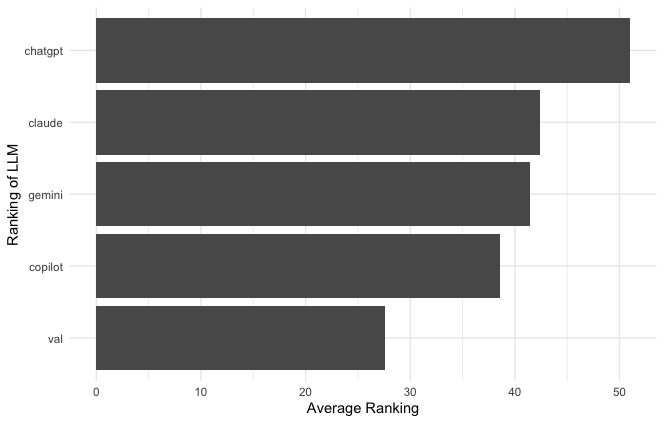
Analysis of Contents from LLM Platforms
LIWC is used for performing the above analysis.
Linguistic Inquiry and Word Count (LIWC) is the gold standard in software for analyzing word use. It can be used to study a single individual, groups of people over time, or all of social media.
Here is the code book with other factors provided by LIWC: LIWC Code Books
Meaning of the above factors:
Analytic: Analytic thinking (Metric of logical, formal thinking)
Clout: Language of leadership, status
Authentic: Perceived honesty, genuineness
Tone: Degree of positive (negative) tone
socrefs: Social References
Emoji: Number of emojies used in content
How different Tweets Are?
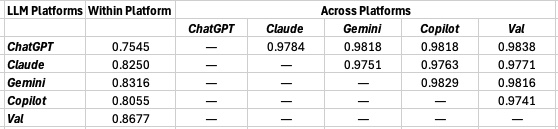
Similarity of tweets is captured using Cosine similarity method. Don’t worry about the method, but its interpretation is very interesting.
The cosine similarity score ranges from -1 to 1.
- 1: Indicates perfect similarity (vectors are pointing in the same direction).
- 0: Indicates no similarity (vectors are orthogonal, at a 90-degree angle).
- -1: Indicates perfect dissimilarity (vectors are pointing in opposite directions).
Main Insight: While LLM platforms have revolutionized content creation, their outputs often exhibit striking similarities both within and across platforms, creating a landscape of digital homogeneity. This algorithmic convergence means that brands relying solely on AI-generated content risk blending into an undifferentiated mass of marketing noise. Human creativity—with its unique insights, emotional intelligence, and cultural nuance—remains the essential differentiator that enables brands to craft truly distinctive voices, forge authentic connections, and ultimately stand out in an increasingly crowded digital marketplace.